SUVmean. PSMA-VOL. ΔVOL. TLQ. The biomarkers behind selection, response, and prognosis — none available from a qualitative read.
Quantitative PSMA PET
Baseline SUVmean is the strongest quantitative predictor of PSA response and overall survival after PSMA RPT. Validated across VISION, TheraP, and the U.S. Expanded Access Program. A qualitative read cannot identify it. An SUVmax read cannot replace it.
≥30% decrease = PR, ≥20% increase plus new lesions = PD. Absence of PSMA uptake = CR. Everything else = SD. The categories are defined against quantitative tumor volume change at baseline and each follow-up — not against a narrative read.
Tumor burden multiplied by PSMA expression. Volume says how much. SUVmean says how avid. The composite outperforms either parameter alone for overall survival in mCRPC across multiple cohorts — and is where the literature is moving.
Response Criteria
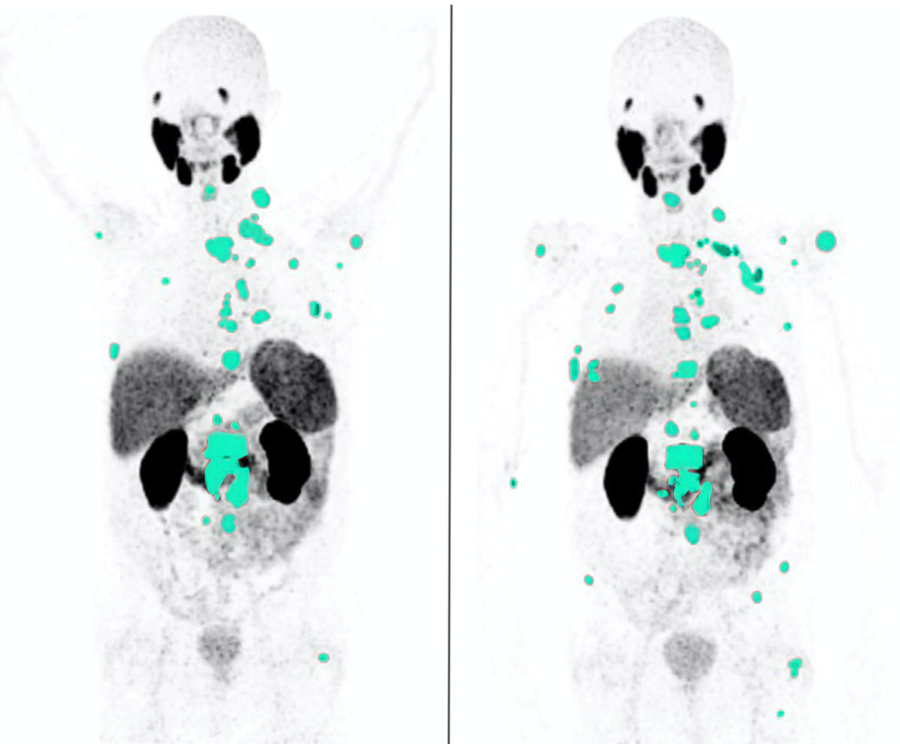
PSMA loss of expression. Neuroendocrine differentiation. Aggressive mCRPC phenotypes. These patients baseline-positive on PSMA and progress through FDG-avid, PSMA-negative lesions your PSMA PET cannot see. TheraP screened for discordance and excluded it. VISION did not screen for it. Across both, FDG+/PSMA− disease predicted shorter OS on 177Lu-PSMA. FDG + PSMA on the same patient, quantified in parallel — when your protocol needs to identify discordance before it drives outcomes.
Quantitative Imaging
Mean PSMA uptake across all quantified tumor.
The single strongest multivariate predictor of PSA response and overall survival after 177Lu-PSMA. Threshold enrichment: SUVmean ≥10. Validated across VISION, TheraP, taxane chemotherapy, and the U.S. Expanded Access Program. Unavailable from a qualitative read.
Whole-body volume of PSMA-avid disease.
Segmented across all lesions using a threshold derived from liver or blood-pool uptake. The quantitative input RECIP 1.0 requires to assign CR / PR / SD / PD. Called PSMA-VOL by Gafita and TTV in later literature — same parameter, two conventions.
Longitudinal percent change from baseline.
Applied directly against RECIP 1.0 cutoffs: ≥30% decrease with no new lesions = PR, ≥20% increase with new lesions = PD. Calculated per patient at each scheduled timepoint. Cannot be reconstructed retroactively from a narrative read.
PSMA-VOL ÷ SUVmean. Volume multiplied by expression.
Composite prognostic biomarker — tumor burden weighted by PSMA intensity. Independently prognostic for OS in mCRPC across multiple cohorts. Directly analogous to TLG in FDG-PET. Stable across software platforms and reconstructions.
Full-Stack Imaging
Why Volumetryx
PSMA-VOL, SUVmean, and ΔVOL as the standard read — not a $500K add-on. Quantification is the substrate of every RECIP 1.0 category and every prognostic composite. Priced and delivered as the standard read — so sponsors don't discover after contracting that the biomarker they need is a change order.
Nuclear medicine readers with PSMA PET/CT subspecialty volume. Not generalist radiologists reading PSMA for the first time on your trial. Our readers are trained in PSMA tracer-specific uptake patterns — PSMA-617, DCFPyL, PSMA-11 — across disease states and post-treatment phenotypes. Adjudication panel for discordant reads.
RECIP 1.0, PPP, aPERCIST, PROMISE V2 — from one vendor. Morphologic criteria (RECIST 1.1, PCWG3) alongside functional PSMA criteria in parallel reads. No separate contracts for CT-based response and PET-based response. No reconciliation drift between two vendors.
FDG + PSMA on the same patient — quantified in parallel. For late-stage mCRPC and suspected discordance. Identification of FDG+/PSMA− disease before it drives trial outcomes. Single imaging infrastructure, two tracers, one audit trail.
Three biomarkers, one scan — only if you quantify. Let's discuss what your protocol actually needs.